
The income protection gap: what physicians often miss about group disability coverage
August 20, 2026 • 6 min read • Educational — not a solicitation for a specific policy
Why can group LTD leave physicians underinsured?
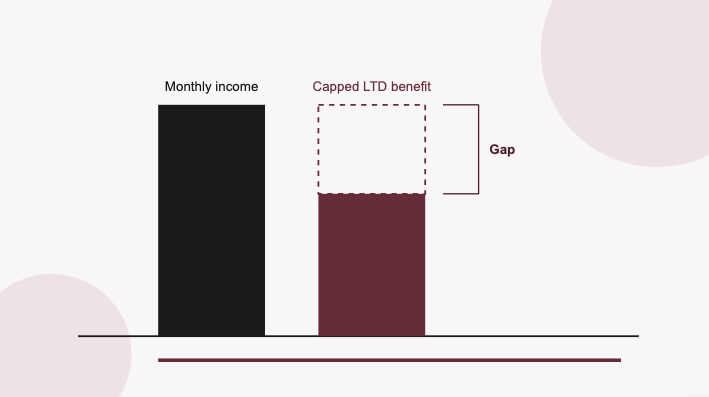
Group long-term disability insurance can leave physicians underinsured because benefits are often capped at a fixed monthly amount and may cover only base salary. Bonus, RVU, productivity and other compensation may not be included, and employer-paid benefits may be taxable. As physician compensation increases, the percentage of actual income protected by the group plan can therefore decrease.
For many physicians, future earnings are one of the largest financial assets they will ever have to protect. That income generally supports housing, student loan repayment, family obligations, retirement savings, practice overhead, and day-to-day living expenses. Income protection planning is simply the process of reviewing what could happen to household finances if an illness or injury limited a physician's ability to practice and earn at their current level.
That conversation typically starts with disability insurance, but it shouldn't stop at "Do I have coverage?" A more useful question is: if you were unable to perform the duties of your specialty, would your current coverage come close to replacing the income your household relies on? Group long-term disability (LTD) insurance can be a reasonable foundation, but it's worth understanding its monthly caps, tax treatment, and how it handles bonus or productivity-based pay before assuming it's enough.
Why physician income can carry unique risk
Physician compensation is often tied closely to specialized, hands-on duties. A surgeon's ability to earn may depend on fine motor control and stamina in the operating room. An interventional cardiologist may rely on procedural skill and call coverage. An emergency physician may depend on cognitive speed and the ability to perform under pressure. Even physicians who don't perform procedures generally rely on sustained concentration, judgment, and communication to do their jobs.
Because of this, disability coverage for physicians is worth reviewing on its own terms rather than treating it as a standard employee benefit. It can help to ask: if I could no longer practice in my specialty, would my current coverage reasonably protect the income my household depends on?
Where the typical group LTD plan may fall short
Many physicians assume employer-provided group LTD coverage is sufficient. Group LTD can be a valuable piece of a plan, but it commonly has structural limits. A typical plan might target replacing 50% to 60% of base salary, but benefits are frequently capped at a fixed monthly dollar maximum. For higher-income physicians, that cap can create a meaningful difference between actual income and the income that is actually insured.
Group LTD plans may also exclude bonus income, productivity or RVU-based compensation, partnership distributions, or moonlighting income. When an employer pays the premium, benefits received may be taxable, which can further reduce what's available to cover monthly expenses. In addition, some group plans use definitions of disability that become less favorable after an initial claim period for example, shifting from "your own specialty" to "any occupation." These are details worth confirming directly with your plan documents or a licensed advisor.
51M+
working adults in the United States are estimated to have no disability insurance coverage beyond Social Security.
~1 in 4
of today's 20-year-olds is projected to experience a disability lasting one year or longer before reaching normal retirement age.
8.6M+
disabled worker beneficiaries received Social Security disability benefits in 2024, with musculoskeletal conditions the most common diagnosis category.
Sources: Council for Disability Income Awareness (CDIA); U.S. Social Security Administration, 2024 disability statistics. Figures are third-party estimates and are cited for general educational context; they are not a projection or guarantee of any individual outcome.
An illustrative example
Consider a physician earning $400,000 per year, or roughly $33,333 per month before taxes. Suppose the employer's group LTD plan targets 60% income replacement but caps the monthly benefit at $10,000. On paper, 60% of income would be $20,000 per month; in this example, the plan's cap limits the actual benefit to $10,000, and if that benefit is taxable, the amount available after taxes would be lower still. This is a hypothetical example for illustration only and is not a projection of benefits under any specific policy.
Hypothetical example — figures are illustrative only and will vary by plan, employer, and individual circumstances.
| Gross monthly income on $400,000 annual income | $33,333 |
| 60% replacement target before plan cap | $20,000 |
| Group LTD maximum monthly benefit (example cap) | $10,000 |
| Estimated pre-tax monthly gap | $10,000 |
That same physician may still be responsible for a mortgage, student loan payments, childcare, insurance premiums, retirement contributions, and ordinary household expenses. A benefit that reads as generous in a benefits booklet may or may not be enough to maintain a household's existing financial plan during a period of disability. The answer depends entirely on the specific numbers involved.
A reasonable first step: know your number
One practical starting point is comparing the income your household currently depends on against what your group LTD plan would actually pay after caps and taxes are applied. For some physicians the difference is minor; for others it is significant. Either way, it's a number worth knowing rather than assuming, and reviewing it with a licensed advisor who works with group and individual disability coverage can help clarify the options available to you.
About the Author
Taylor Collins, CLU, RHU, CEBS
President, Professional Benefits Incorporated — Sarasota, Florida
Not sure what your group plan would actually pay?
A complimentary review can help identify whether — and where — a gap may exist between your income and your current coverage. There is no obligation, and results will depend on your individual plan, health, and state of residence.
Important information: This article is provided for general educational purposes only and does not constitute insurance, legal, tax, or financial advice, nor an offer to sell or a solicitation to buy any specific insurance product. Disability insurance products are issued by third-party insurance carriers, not by Professional Benefits Incorporated (PBI). PBI is an independent insurance broker; availability, terms, definitions of disability, benefit amounts, exclusions, and pricing vary by carrier, by state, and are subject to underwriting approval. Nothing in this article guarantees eligibility, approval, or a specific benefit amount for any individual. Figures and statistics cited are drawn from third-party sources current as of their publication date and are subject to change. Florida residents and residents of other states should confirm product availability and terms with a licensed insurance professional in their state before making any coverage decisions.