
In the first post of this series, we mapped the layers of income protection and noted a quiet problem: the higher your income, the smaller the share of it your group long-term disability (LTD) plan actually protects. This post takes that problem apart piece by piece explaining where the gap comes from, how large it really is once taxes are counted, and how an individual disability policy rebuilds the coverage a group plan structurally cannot.
How group long-term disability is designed and why That Generates a Gap
A typical group LTD plan replaces about 60% of pre-disability earnings. For an employee earning $80,000, that’s roughly $4,000 a month, and the plan delivers close to what the formula promises. Although 60% of income before taxes may not be sufficient depending on your personal situation, Group LTD is not broken and does its job well for most employees. The rest of this article focuses on the biggest problem which is specific to one segment: high earners.
Two features of group plans cause high earners to be underserved by Group LTD.
Feature 1: The monthly benefit cap
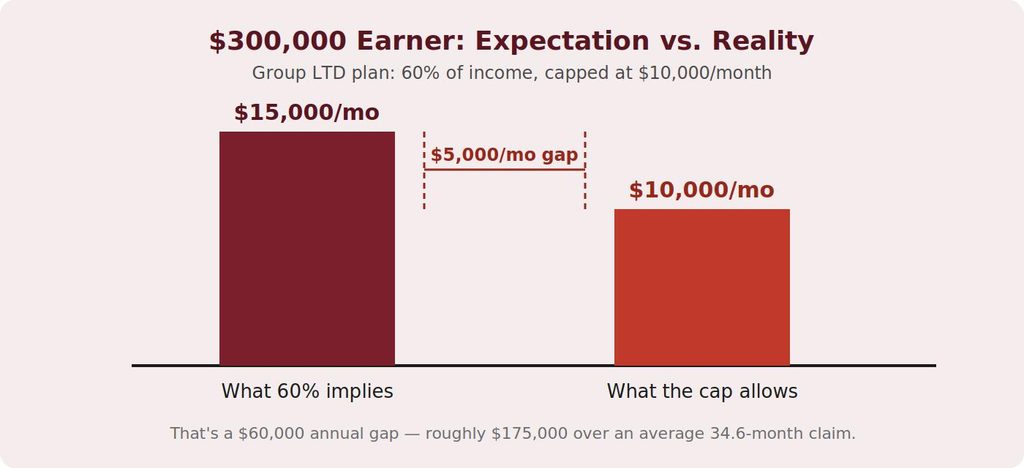
Almost every group plan applies a maximum monthly benefit which is commonly in the range of $10,000 to $15,000. The 60% replacement only holds until you hit that ceiling. Above it, the percentage silently erodes.
For example, consider a plan capped at $10,000/month. An executive earning $300,000 usually sees the 60% and expects $15,000/month (60%), but the cap limits them to $10,000 which is a $60,000 annual shortfall. With the average LTD claim lasting nearly three years, that single piece of the gap represents roughly a $175,000 shortfall over the life of a typical claim.
Feature 2: What counts as “covered earnings”
Group plans frequently cover base salary only. Bonus, commission, RVU/production income, K1 income and equity compensation, often a large share of sales / physician / executive pay may fall entirely outside the calculation. For example, an executive whose total comp is $250,000 but whose base is $175,000 may find the plan calculates from the smaller number, then also applies the cap.
Taxes makes the gap wider than it looks
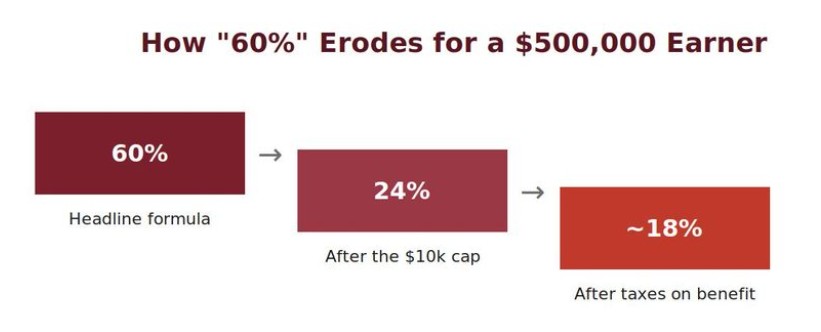
Here’s the part most people miss entirely. When your employer pays the LTD premium, as is usual for group coverage, the benefit you receive at claim time is generally taxable income. So the headline “60% of income” is really 60% before tax, on a benefit that’s already been capped.
This makes the gap relevant for most white collar individuals but lets play it out for a $500,000 earner on a group plan alone. With a $10,000 cap and then federal and state taxes on that benefit, take-home can land closer to $7,500–$8,000 a month. Measured against a $500,000 lifestyle, the effective replacement ratio drops well below 20%, and the real annual gap can exceed $400,000.
The mirror image is the good news: when the individual pays the premium with after-tax dollars, the benefit is received tax-free. That single structural choice is one of the most powerful levers in designing supplemental coverage, as there is a big tax upside to having the executive bear the cost.
Why this hits high earners hardest — the lifestyle problem
A shrinking replacement ratio would matter less if expenses shrank with it. They don’t. As income grows, fixed obligations tend to grow alongside it: a larger mortgage, private school tuition, higher retirement contributions, and the rest. Fixed obligations don’t pause when a disability occurs. The household with the most to lose from an income interruption is often the one whose group plan protects the smallest slice of income.
It’s worth naming the irony plainly: this is sometimes called reverse discrimination in benefits design. The employees a company most wants to attract and retain, its highest earners, are the ones whose standard benefit protects them least.
Closing the gap with individual disability insurance (IDI)
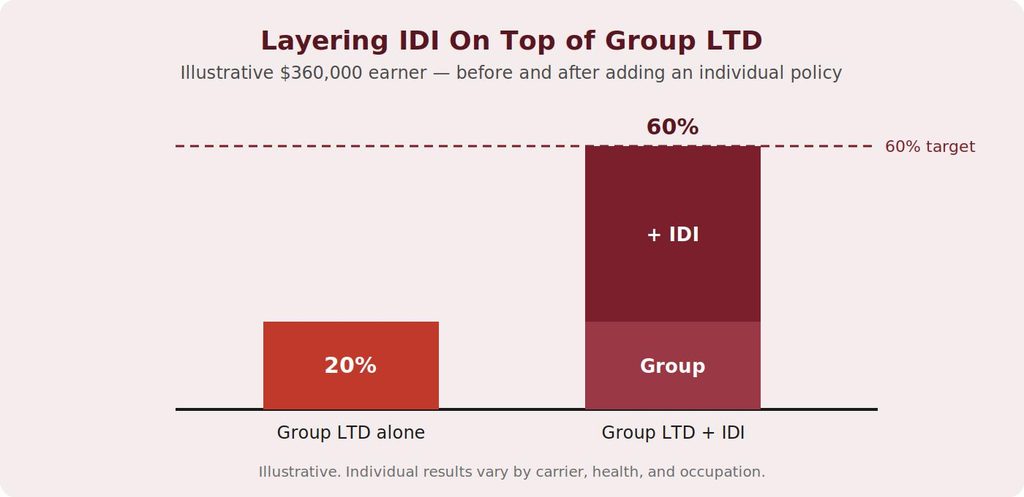
The standard fix is to layer an individual disability insurance (IDI) policy on top of group LTD. IDI is a personally owned policy that sits above the group plan, picking up income the group cap leaves uncovered and typically restoring the total replacement ratio toward 60–70% of income. We often encourage the employer to fix the reverse discrimination by targeting the same percentage replacement as the group LTD, which is also more cost effective than targeting the maximum possible benefit. Because the individual generally pays the premium, that added layer also usually pays out tax-free.
The impact is concrete. Consider an executive earning $360,000 whose group LTD plan, after its monthly cap, protects only about 20% of income. Layering an individual policy on top picks up the uncovered income and can bring total protection to the full 60% target, the benchmark generally considered adequate to maintain a household’s standard of living.
Two catches worth knowing before you shop
IDI is powerful, but the window to get obtain it is not open forever, for two reasons.
Medical Underwriting is rigorous. Individual disability insurance is among the most carefully underwritten products in the industry. A common rule of thumb: of every four applicants, roughly two are approved as applied, one is declined, and one is approved with an exclusion or a rating. When is the best time to buy disability insurance? When you are healthiest, which is usually when you are youngest.
Limitations exist. Carriers cap how much individual coverage they’ll write, and they coordinate with your existing group benefit. For very high earners, incomes well into the seven figures, even group LTD plus a standard IDI policy may not reach 60%. That’s where a third tier, high-limit disability insurance written through specialty markets, can extend protection further. HLDI is a topic in its own right and one we’ll return to later in the series. There are also restrictions on occupation, visa status and other things such as risky hobbies. Some limitations vary by insurance company, some are universal limitations.
A practical starting point
If you’re a high earner wondering whether you’re exposed, three steps bring the picture into focus:
- Pull your group LTD plan document. Find the replacement percentage, the monthly cap, and whether the definition of covered earnings includes bonus and commission. Most people have never read this page.
- Do the cap math on your own income. Divide the annual cap by your total compensation. If the result is well under 60%, you have a measurable gap.
- Check who pays the premium. Employer-paid means taxable benefits; that alone can move your real replacement ratio by ten points or more.
Those numbers tell you the size of the gap an individual policy would need to fill. In the next post, we go inside the individual policy itself — the riders that shape how and when it pays, and how to decide which ones are worth their cost.
Guaranteed Standard Issue
What is Guaranteed Standard Issue? Guaranteed Standard Issue Disability Insurance is supplemental individual disability coverage offered to eligible employees through an employer or qualifying group with little or no individual medical underwriting. It is commonly used for executives and highly compensated employees whose group long-term disability plan leaves part of their income unprotected because of monthly benefit caps. We will have an entire post dedicated to this subject in the near future.
However, in summary it is common at larger employers such as hospitals or larger multi-specialty clinics to have a very large group of individuals who all have a significant gap in terms of income protection. There is a perfect fit for a Guaranteed Standard Issue program and usually allows for the option to have a voluntary program where the physicians or executives pay the premium. However you can start an employer-paid Guaranteed Standard Issue program where there is no medical underwriting needed with 4 executives who all need coverage beyond the group LTD. You can also mix and match with the right size of employer, have the C-suite paid for by the employer as a perk and add a voluntary offering to all the other employees so they have the choice to pay for their coverage.
Care needs to be taken to select the correct insurance company who is willing to do this, offers the full benefit needed to replace income and makes the initial and ongoing administration as easy as possible. That is where a broker who specializes in this type of benefit and has experience with voluntary enrollment for this type of benefit (which is unique to other voluntary programs) comes in.
The takeaway
Group long-term disability works well for most employees but poorly for high earners. Not by accident, but by design. The monthly cap, the base-salary-only definition, and the taxability of employer-paid benefits combine to shrink a 60% headline into an effective replacement ratio that can dip below 20% for a top earner. An individually owned disability policy, layered on top and paid with after-tax dollars, is the standard tool for rebuilding that protection, provided you secure it while your health still qualifies you.
Author – Taylor Collins, CLU, RHU, CEBS
President, Professional Benefits Incorporated — Sarasota, Florida
View full bio at professionalbenefits.org/meet-the-team
Not Sure Where Your Plan Has Gaps?
A free benefits review can help identify where your current plan design may be over-
or under-serving parts of your workforce.
Sources: Anchin, Bridging the Executive Disability Gap (2025); Council for Disability Income Awareness (2026).
This article is for educational purposes only and is not individualized financial, tax, or insurance advice. Coverage terms, tax treatment, and underwriting outcomes vary by policy, carrier, and individual circumstance. Consult a licensed professional regarding your specific situation.