
For a resident or new attending, the most valuable asset isn’t a house or a portfolio it’s the future earning power that years of education have been building toward. A single disabling illness or injury during or after training can erase millions in lifetime income. Yet residency is also the moment when protecting that asset is easiest and cheapest, and when a specific, time-limited opportunity is available: a Graduate Medical Education (GME) Guaranteed Standard Issue (GSI) disability program.
This post explains what a GME GSI program is, why the enrollment window matters so much, and why residents who wait often find the door has closed.
What a GME GSI program is
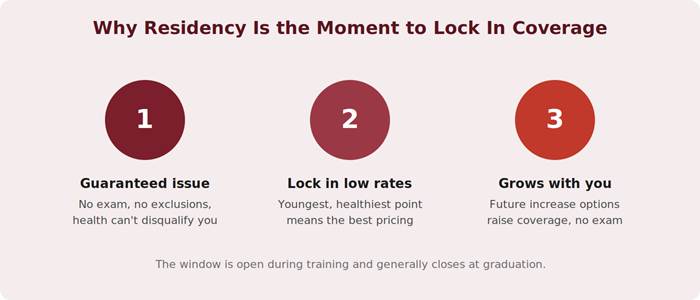
A GME Guaranteed Standard Issue program offers residents and fellows at a participating institution an individual, own-occupation disability policy with no in-depth medical underwriting. There’s no medical exam, no health questionnaire for the base coverage, no exclusions for pre-existing conditions, and no possibility of being declined.
Eligibility is based on:
- your status as a trainee at a participating program and
- not already being on or eligible for a claim and
- not having applied elsewhere and got a unfavorable result (i.e. exclusions, rating, declines)
These programs are offered at a limited number of teaching hospitals nationwide through select carriers Ameritas is one of the carriers that offers GME-focused GSI coverage for residents and fellows.
The word “individual” matters. This isn’t a group benefit that evaporates when you leave training, it’s your own policy. As long as you pay the premiums, it stays with you at the same terms as you move from residency to fellowship to attending, across employers and specialties, for the rest of your career.
Why this matters most for residents with health histories
Fully underwritten disability insurance is rigorously reviewed. A history that seems minor can change everything: ADHD medication, an antidepressant prescription, a past sports injury, a pregnancy complication, or high-risk hobbies like rock climbing or scuba diving can each trigger an exclusion, a premium rating, or a decline on a traditional individual policy. Industry data has long shown that a substantial share of applicants, on the order of a third, get approved but with modifications like higher premiums, exclusions, or benefit limits.
Under a GME GSI program, none of that applies. The policy issues at standard rates regardless of what’s in your medical record, because approval is based on your training status rather than your health. For a resident who already has something in their history that a traditional underwriter would flag, GSI can be the difference between solid own-occupation coverage and no good options at all.
The catch: one application can cost you eligibility
There’s a critical eligibility rule that trips up residents who try to shop on their own first. In most programs, a resident must not have previously applied for individual disability insurance with another carrier. The application itself can trigger disqualification, regardless of whether a policy was issued, declined, or rated. But if you get an unfavorable result every program will decline you. A resident who applied online through an unfamiliar agent, picked up an exclusion, and then arrived at a GSI-eligible program may have already lost access to the program before they knew it existed.
This is why the advice for residents is important: GSI should often be the first disability policy you apply for, not the last. Explore the guaranteed-issue program available through your institution before submitting any individually underwritten application. This is the advice we give all residents regardless if they are eligible for a program we sell.
What the coverage looks like
GME GSI policies are designed for where residents are now and where they’re headed and are usually:
- Own-occupation, specialty-specific protection. Coverage is based on your medical specialty which is the definition physicians want, since it pays if you can’t perform your own specialty, even if you could do other work.
- A base benefit sized for training income, with monthly benefit amounts set by the program, modest during residency but meaningful, and structured to grow.
- Future increase options. As your income climbs from resident to attending, most GSI policies let you raise coverage without new medical underwriting. Protection keeps pace with earnings even if your health has since changed.
- Portability and some customization. The policy is yours to keep, and while GSI offers less flexibility than a fully underwritten policy, riders can still tailor it.
Graded Premium vs. Fixed Premium: What’s the Difference?
When you buy an individual disability policy, the premium structure matters nearly as much as the benefit itself. Two choices come up often, particularly for residents, fellows, and early-career professionals: a graded premium and a fixed (level) premium.
Fixed premium (a.k.a. noncancelable). A noncancelable policy generally means the insurer cannot cancel the coverage, change its terms, or raise the premium as long as you pay on time, up to the policy’s stated maximum age. The fixed-premium policies are priced at a level amount based on your age at issue. You pay more upfront than you would on a graded policy, but the cost is known from day one.
Graded premium (a.k.a. guaranteed renewable). A graded premium policy starts with a lower premium that is scheduled to step up over time, often at specified ages or policy anniversaries. The schedule is typically set at the time of purchase, which does reduce the initial premium. The tradeoff is that the premium will rise, and become very expensive as the probability of needing a claim increases. You need to remember to switch to fixed price before you age out of the window and the fixed price premium is always going to be more than what you are paying at the time.
Guardian is a good contract in general but is known for encouraging this approach for GME GSI programs, however we regularly have attendings referred to us that do not want to convert to the fixed premium with Guardian because it is now too expensive or they are outside the window to convert.
| Graded Premium (Guaranteed Renewable) | Fixed (Noncancelable) | |
|---|---|---|
| Starting cost | Generally lower | Generally higher |
| Premium over time | Increases on a set schedule | Stays level |
| Predictability | Known schedule, but costs rise | Known and constant |
How to choose. We do not sell graded premium contract generally speaking because it is not prudent long term planning. In our opinion you are better off starting with a smaller contract and increasing it in the future as your income increases instead. Among the carriers we work with for individual underwritten disability coverage (Guardian, Principal, Standard, Ameritas, and Mass Mutual) many have options for both and we stick with the fixed price route. That said the options, step-up schedules, and renewability features differ, so compare the contract language and not just the first-year premium.
A note on taxes. Premiums paid personally with after-tax dollars generally result in income-tax-free benefits under IRC §104(a)(3). If an employer pays the premium, the treatment of benefits may differ under §105. How premiums are structured and paid can affect this, so confirm with your CPA or tax attorney.
GSI or fully underwritten — which is right?
GSI isn’t automatically the only answer. For a perfectly healthy resident, a fully underwritten policy may offer additional options such as full mental nervous coverage or higher benefit amounts. The good news is that these aren’t always mutually exclusive, some programs let residents pursue both paths, and an advisor can compare them. The key is simply to understand the options before acting, because the one irreversible mistake is unknowingly forfeiting GSI eligibility by submitting an underwritten application first. Even hen there’s no question about whether a resident would clear underwriting cleanly, GSI is usually the prudent first move. You can always come back and cancel the GSI policy after the underwritten one is in place.
The real cost of waiting
It’s tempting for a resident to defer disability coverage as income is low, schedules are brutal, and retirement feels far away. But waiting carries a specific, compounding cost that’s easy to underestimate.
First, health rarely gets simpler with time. Even though the bar is higher than for underwritten policies there is still a threshold. If you claim on any kind of disability benefits (including VA) you will become ineligible until you have been off claim long enough to be eligible again. We have also seen situations where the resident has had a debilitating stroke, became deaf and other health situations arise that make them eligible for a claim, which naturally makes you ineligible to start a new income protection contract. The guaranteed-issue window is, in effect, a chance to lock in coverage before life has a chance to complicate it.
Second, pricing is age-based. Disability premiums are lowest when you’re youngest and healthiest. A policy secured in residency is generally cheaper for its entire life than the same coverage purchased years later as an attending. Even with future increase options, that early, favorable rate structure carries forward as you raise coverage. This normal means it makes the most sense to apply right before your birthday, especially in your graduating year where the window for eligibility is start to near.
Talking of which, third, and most important, the guaranteed-issue opportunity itself expires. Once training ends, the GSI door generally closes, and coverage reverts to full medical underwriting with no guarantee of approval. A resident who waits isn’t just paying more later, they may be trading a sure thing for a maybe. For a young physician whose entire financial future rests on the ability to practice, that’s a meaningful gamble to take with the one asset that funds everything else. What I really love about the Ameritas program is you have up to 6 months after you graduate to apply but after the 6 months lapses, there is no coming back.
Frequently Asked Questions
What is a GME Guaranteed Standard Issue (GSI) disability program?
A GME GSI program offers residents and fellows at a participating teaching hospital an individual, own-occupation disability policy that is issued without medical underwriting. Eligibility is based on your status as a trainee at a participating institution rather than your health history, so there is generally no medical exam or health questionnaire for the base coverage. The policy is individually owned, so it is designed to stay with you as you move from residency to fellowship to practice, as long as premiums are paid. These programs are available only at select institutions through select carriers, and benefit amounts, eligibility rules, and enrollment windows vary by program. Check the details of the program at your hospital.
Can applying for another disability policy first affect my Guaranteed Standard Issue eligibility?
Yes. Many GME GSI programs require that you have not previously applied for individual disability insurance with another carrier. In some programs, the application itself can end eligibility, even if the application was not declined, rated, or never resulted in a policy. Because rules differ by carrier and institution, confirm your program’s requirements before submitting any individually underwritten application. Many advisors suggest exploring the GSI program available through your institution first, then comparing it with other options if appropriate.
How do I find out if my residency program has a Guaranteed Standard Issue income protection option?
Your program director or coordinator should have information on any endorsed program. The largest insurance company of endorsed GME Guaranteed Standard Issue programs is Ameritas and you can find a list of their programs here https://ameritas.visme.co/view/kkdw3p1v-ameritas-gsi-gme-residency-programs
Guardian offers many unendorsed programs where they are not approved by the residency program. You can find those here https://www.disabilityquotes.com/gsi make sure you ask for a price that is fixed to at least age 65.
If you are a resident, you should ask an advisor about these types of programs if they recommend disability insurance.
The takeaway
A GME GSI program is a rare, time-limited opportunity to protect a physician’s most valuable asset, their future earning power, at the point in a career when it’s easiest and cheapest to do so. It delivers individual, own-occupation, portable coverage with no medical underwriting, which is especially valuable for any resident whose health history might otherwise mean exclusions or a decline. The window is open during training and generally closes at/ close to graduation. A single prior application elsewhere can end eligibility, so for most residents, exploring the guaranteed-issue program available through their institution should come first, before any other disability application.
Still in training and want to protect your future income the smart way?
We can help you understand your GSI options before the window closes and before any misstep costs you eligibility. To find out more, get in touch with our team.
| About the Author Stevan Collins, CLU, CEBS, DIA Executive Benefits Consultant, Professional Benefits Incorporated — Sarasota, Florida View full bio at professionalbenefits.org/meet-the-team |
This article is for general educational purposes only and is not individualized financial, tax, legal, or insurance advice, and is not a contract, an offer of insurance, or a guarantee of coverage or benefits. Policy features, tax treatment, and availability vary by carrier and jurisdiction; buy-sell arrangements should be coordinated with qualified legal counsel. Consult licensed professionals regarding your specific situation. Professional Benefits Incorporated is a Florida-based independent insurance brokerage; product and licensing availability may vary by state.