
Earlier in this series we established the core problem for high earners: group long-term disability (LTD) caps benefits at a level that protects a shrinking share of income as pay rises. Combine that with the fact that buying an individual policy the traditional way means clearing rigorous medical underwriting where a meaningful share of applicants are declined, rated, or have pre-existing conditions excluded. Guaranteed Standard Issue (GSI) disability insurance, delivered as an executive or physician carve-out, is the employer-sponsored solution designed to solve both problems at once.
What a GSI carve-out is
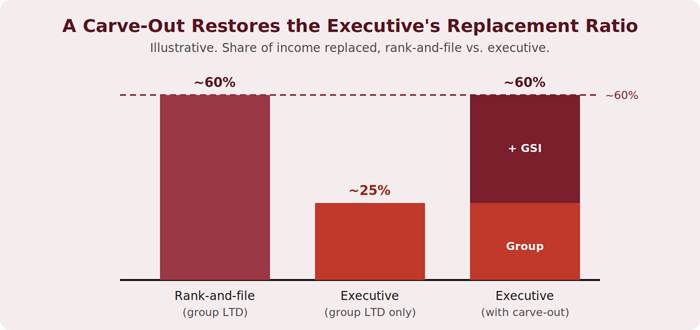
A Guaranteed Standard Issue program lets an employer offer executive-owned disability policies to a defined class of highly compensated employees. Whether that is executives, physicians or partners with little or no individual medical underwriting. The term “carve-out” captures the idea: you carve out a select group from the broader workforce that are not fully protected by the group benefits and give them supplemental coverage that sits on top of the base group LTD plan. Typically restoring their replacement income percentage in the event of disability to something comparable to what lower-paid employees already enjoy.
Two features make it powerful:
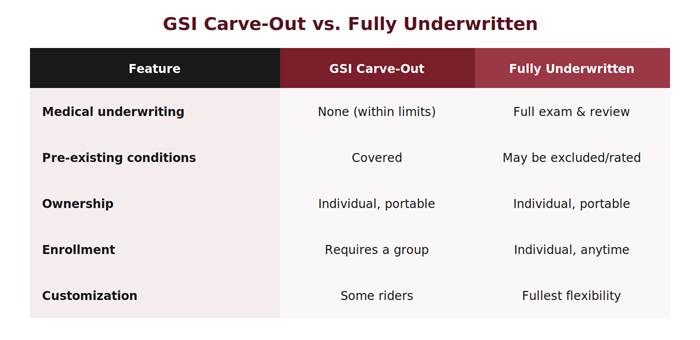
- No medical underwriting. Within program limits, coverage is guaranteed and issued based on the person’s membership in the eligible class, not their health history. Someone with a condition that would trigger an exclusion or decline on a fully underwritten policy still gets full, standard coverage. Sometimes there are 3-4 questions to confirm eligibility but there are options for this type of program that don’t ask individuals ANY questions.
- Individually owned and portable. Unlike group LTD, these policies are true individual contracts from the start of their existence. The employee keeps the coverage, at the same terms (including price) if they change employers, and because it’s typically own-occupation coverage, it protects their specific profession even as that profession changes.
Why employers offer it
A GSI carve-out is as much a talent strategy as a benefits decision. The employees a company most wants to recruit and keep, its highest earners, are precisely the ones whose standard group LTD protects least. Closing that gap does several things at once:
- It corrects an equity problem. Restoring executives to roughly the same replacement percentage as everyone else removes the “reverse discrimination” baked into capped group plans.
- It’s a recruiting and retention tool. Comprehensive income protection is a tangible differentiator for leadership talent, and financially secure executives are less likely to leave. Once an employee has witnessed the effect of a claim with or without this coverage, it is a powerful motivator.
- It’s efficient to administer. Because coverage is guaranteed-issue (within limits), enrollment is simple and often just confirming eligibility rather than completing health questionnaires and exams. There are even some options where all that is needed is for the employer to provide a spreadsheet of demographic details and to sign the employer paperwork, no individual applications needed.
How participation works
Because carriers are waiving medical underwriting, they manage risk at the group level through participation rules rather than individual health review. The exact thresholds vary by carrier, but the general pattern looks like this:
- Smaller eligible groups (for example, more than 5 but fewer than about 50 participants) often require full participation of the eligible class, with the employer typically funding the premium. These employer funded classes are typically where the executive does not need to complete paperwork.
- Larger groups (roughly 50+ eligible) may permit voluntary enrollment, contingent on a minimum percentage of eligible employees signing up. This is typically in the 15-20% enrollment being required and requires a strong education program so that employees know the program exists and the value of it before deciding whether to enroll. The backbone of a good enrollment for a voluntary program is a partnership with Human Resource and the broker to deliver the education and enrollment in the best way for the employees.
These minimums exist so the carrier gets a broad, representative slice of the group rather than only those who expect to claim, the same logic that makes guaranteed issue possible in the first place. Structuring the class, the funding, and knowing how to get the participation is where an experienced benefits advisor earns their keep.
Two most Common Carveouts
GSI carve-outs show up most often in two settings, and the emphasis differs.
Corporate executives. Here the driver is usually total compensation that group LTD does not cover, large bonuses, incentive pay, K-1 Income and equity that fall outside the plan’s covered-earnings definition, compounded by the monthly cap. A carve-out layers individual coverage on top so a leadership team’s protection reflects their total income, not just base salary.
Physicians and medical groups. For hospitals, physician groups, and practices, GSI does double duty: it restores the replacement ratio for high-earning specialists and guarantees coverage to physicians whose medical histories (or high-risk avocations) might otherwise draw exclusions or ratings on a fully underwritten policy. Own-occupation, specialty-specific protection is the standard physicians want, and GSI delivers it without the underwriting gauntlet.
The carriers behind these programs
GSI is a specialized product line offered by a subset of the major disability carriers. The programs we work with for guaranteed standard issue disability insurance include Ameritas, MetLife, MassMutual, MGIS, Guardian, Principal, Standard and Unum. Each has its own employer funding requirements, eligibility rules, enrollment approach, benefit maximums, participation thresholds, and rider options, so matching the right carrier to a particular executive class or medical group is a big part of designing a program that actually issues cleanly and serves the members well.
In the situation where coverage is needed beyond the domestic carieers we also have experience implementing Guaranteed Standard Issue programs through Lloyd’s of London with either of our 2 cover holders. Each coverholder also has their own approach and design of these programs.
A note on timing and coordination
GSI works best as part of a coordinated plan rather than a standalone purchase. Because coverage layers on top of group LTD, the design should account for how much the base plan already provides, what counts as covered earnings, and where the combined benefit lands as a percentage of true income. And because these are individual policies, the coverage an executive or physician secures through a carve-out stays with them for the rest of their career which makes getting the structure right at the outset especially valuable.
For a voluntary offering it is important to make sure that the open enrollment for all other benefits does not happen at the same time as the GSI enrollment, so that eligible individuals can spend time reviewing this critical option in isolation.
Designing a GSI program
Two GSI carve-outs can look similar on paper and perform very differently in practice. The details that separate a strong program from a mediocre one tend to cluster around a few decisions:
- The right benefit target. The goal is usually to bring the combined group-plus-GSI benefit to roughly the same replacement percentage the rest of the workforce enjoys. Setting the individual layer too low leaves the gap open; setting it without regard to the base plan risks coordination issues at claim time.
- A clean class definition. Carriers want a clearly defined, non-discriminatory class for example “all vice presidents and above” or “all attending physicians”. A well-drawn class keeps the program simple to administer and helps it renew smoothly year over year.
- Sensible funding. Whether the employer pays, the employee pays, or the cost is shared affects both the tax treatment of benefits and participation. Employer-paid benefits are generally taxable; employee-paid benefits are generally tax-free.
- Own-occupation language. For physicians and executives especially, confirming a true own-occupation definition in the carve-out is essential; it’s the feature that protects a specific professional skill set.
None of this is visible from a quote sheet alone, which is why program design of matching carrier, class, funding, and benefit target to a particular employer is the substance of the work rather than a formality.
Frequently Asked Questions
What is a Guaranteed Standard Issue (GSI) executive carveout?
A GSI executive carve-out is an employer-sponsored program that offers individual disability insurance policies to a defined class of highly compensated employees, such as executives, physicians, or partners. The coverage sits on top of the company’s base group long-term disability (LTD) plan, which often caps benefits well below what a high earner actually makes. Within the program’s limits, coverage is generally issued based on membership in the eligible class rather than individual health history, so medical underwriting is typically minimal or waived. The policies are individually owned, so the coverage is designed to stay with the employee if they change employers.
What happens to my GSI coverage if I leave my employer?
GSI policies are individually owned, so the coverage is designed to be portable. In most programs you can keep the policy after leaving, generally by taking over the premium payments if the employer was paying them. Group LTD coverage, by contrast, typically ends when employment does. Review the portability provisions of your specific policy, or ask your advisor, before making a job change.
How are GSI disability benefits taxed?
It depends on who pays the premium and how it is reported. In general, under IRC §104(a)(3) and §105, benefits from a policy whose premiums are paid by the employer and not included in the employee’s taxable income, are usually taxable when received. Benefits from a policy paid with the employee’s after-tax dollars are generally income-tax-free. Some carve-out programs are structured so the employer pays the premium and reports it as taxable compensation to the employee, which can change how benefits are treated. Because the right structure depends on your circumstances, confirm the approach with your CPA or tax attorney before choosing a funding method.
The takeaway
A GSI executive or physician carve-out solves the two problems high earners face with disability coverage: the group LTD cap that shrinks their replacement ratio, and the medical underwriting that can exclude or decline them on an individual policy. By offering guaranteed-issue, individually owned, portable, own-occupation coverage to a defined class of highly compensated people, a carve-out restores executives and physicians to a replacement ratio comparable to the rest of the workforce while giving employers a genuine recruiting and retention advantage. The details of carrier selection, class definition, participation, and coordination with the base plan are where a well-designed program is won or lost.
About the Author Stevan Collins, CLU, CEBS, DIA Executive Benefits Consultant, Professional Benefits Incorporated — Sarasota, Florida View full bio at professionalbenefits.org/meet-the-team
This article is for general educational purposes only and is not individualized financial, tax, legal, or insurance advice, and is not a contract, an offer of insurance, or a guarantee of coverage or benefits. Policy features, tax treatment, and availability vary by carrier and jurisdiction; buy-sell arrangements should be coordinated with qualified legal counsel. Consult licensed professionals regarding your specific situation. Professional Benefits Incorporated is a Florida-based independent insurance brokerage; product and licensing availability may vary by state.
Sources: Council for Disability Income Awareness, How GLTD Can Impact High-Income Earners (2025); Ameritas, Disability Income Insurance for Business Owners (2025); Guardian, Disability Income Insurance Riders. Carrier program details vary; figures shown are illustrative.
This article is for general educational purposes only and is not individualized financial, tax, legal, or insurance advice, and is not a contract, an offer of insurance, or a guarantee of coverage or benefits. Policy features, tax treatment, and availability vary by carrier and jurisdiction; buy-sell arrangements should be coordinated with qualified legal counsel. Consult licensed professionals regarding your specific situation. Professional Benefits Incorporated is a Florida-based independent insurance brokerage; product and licensing availability may vary by state.