Most disability planning focuses on the individual: replacing a paycheck when illness or injury stops it. But for business owners, and for companies that depend on a few essential people, a disability creates a second, separate problem. The bills don’t stop, the revenue that one person generated disappears, and an ownership stake can suddenly need to change hands. Personal disability insurance doesn’t solve any of that as it’s designed to protect the individual’s household, not the enterprise.
This post covers three coverages built to protect the business itself: key person disability insurance, business overhead expense (BOE) insurance, and disability buy-sell (buy-out) insurance. Each solves a distinct problem, and together they can form a business continuation plan for a risk owners are statistically more likely to face than death.
Key Person Disability Insurance
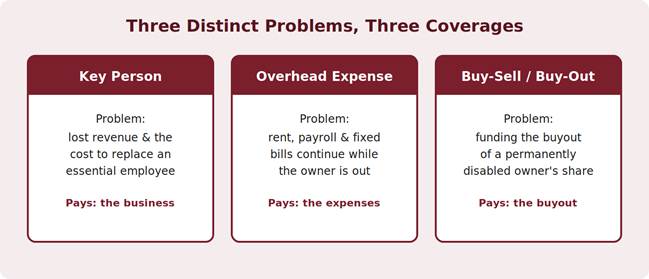
Some businesses rest heavily on one or two people. For example, rainmakers who bring in most of the revenue, a founder whose relationships hold the company together, a specialist no one else can replace overnight. If that person is disabled, the business can absorb a double hit: the income they generated falls, while expenses rise as the company scrambles to hire temporary help or recruit a permanent replacement, and cash flow can suffer further if clients leave amid the uncertainty.
Key person disability insurance is generally structured to pay benefits to the business (which owns the policy) when a covered key employee becomes disabled. The company can use those funds to stay afloat and cover the cost of finding a replacement. Monthly benefits are often designed around the key person’s compensation or an estimated impact of the loss. The policy typically uses a total, own-occupation definition of disability. Which means the Key Person needs to be totally disabled in the key role to trigger benefits. Coverage is usually structured for key employees who own less than a controlling stake in the company, bridging the gap until the person recovers or a successor is in place.
Business Overhead Expense (BOE) Insurance
When the disabled person is the owner, especially in a small practice or closely held firm, the risk is that the doors close while they recover. Rent, utilities, staff salaries, equipment leases, insurance, and loan payments all continue even though the owner’s revenue-producing ability has stopped. For a physician, dentist, attorney, or accountant whose personal presence essentially is the business, reserves can drain quickly.
BOE insurance is designed to reimburse the business for actual, covered operating expenses while the owner is disabled, and can cover up to 100% of eligible costs depending on the policy.
A few features are worth understanding:
- It reimburses real expenses, not a fixed benefit: unlike personal disability insurance, which pays a set monthly amount, BOE generally pays based on the actual overhead the business incurs, up to the policy limit.
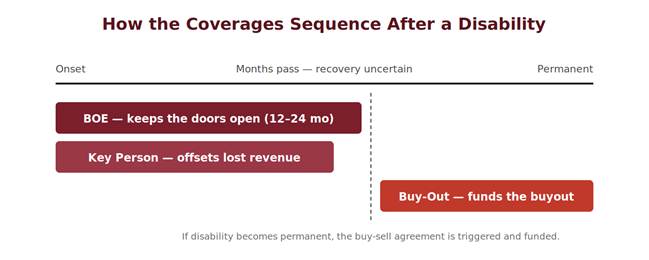
- Benefit periods are short by design: most policies cover expenses for 12 to 24 months. This is meant to help keep the business running while the owner recovers or arranges to sell or wind it down.
- Look for partial or residual benefits: stronger policies pay on partial disability, not only total disability, which matters since many disabilities reduce capacity rather than eliminate it.
- The tax treatment is favorable in a specific way: BOE premiums are generally tax-deductible as a business expense; benefits received are typically taxable, but the overhead they reimburse is itself deductible, so the two tend to offset. Consult a tax advisor about your specific situation.
BOE is a separate policy from personal disability insurance and cover different risks. Several of the carriers we work with including Guardian, Principal, Standard, Ameritas, and MassMutual, write both personal protection policies and BOE.
Disability Buy-Sell (Buy-Out) Insurance
A third problem can appear when a co-owner becomes permanently disabled. A buy-sell agreement governs what happens to their ownership interest, but an agreement is only as useful as its funding. Without a dedicated funding source, the remaining owners may need to drain cash, take on debt (often hard to secure precisely when a key contributor is out), or sell assets to buy out the disabled partner’s share.
Disability buy-out insurance is designed to provide funds to purchase a disabled owner’s interest under the buy-sell agreement. A few essentials:
- The agreement generally must exist first: most carriers require a buy-sell agreement to be in effect as a condition of paying benefits. The policy funds the agreement; it doesn’t replace it. Coordinating coverage with an attorney-drafted agreement is part of doing this correctly.
- It’s built for long-term, total disability: buy-out coverage generally triggers only once a disability is clearly permanent, which is why it pairs naturally with BOE.
- Benefits are typically received income tax-free, since buy-out premiums are generally not tax-deductible which is the exact opposite of BOE’s tax treatment. Confirm current tax treatment with a qualified advisor.
How the Three Work Together
These coverages aren’t alternatives; they’re often a sequence.
Consider a co-owner who suffers a serious disability. In the early months, BOE can help keep the practice’s doors open while key person coverage offsets lost revenue and replacement costs. If the disability turns out to be permanent, the buy-out policy can then fund the purchase of that owner’s share under the buy-sell agreement. This lets the disabled owner exit with fair value while the business continues for everyone else.
Why Owners Overlook This — and Shouldn’t
Business owners routinely insure against fire, liability, and the death of a partner, yet often leave the more likely event, a disabling illness or injury during working years, unfunded. The Social Security Administration estimates that a 20-year-old today has roughly a 1-in-4 chance of becoming disabled before reaching full retirement age. For a closely held business whose value and cash flow depend on a handful of people, that’s not a remote contingency. A business continuation plan that addresses death but not disability is only half a plan.
Frequently Asked Questions
What is key person disability insurance?
A policy owned by the business that pays benefits directly to the company if an essential employee becomes disabled. It helps cover lost revenue and replacement costs, bridging the gap until that person recovers or a successor is in place.
What is business overhead expense (BOE) insurance?
Coverage that reimburses a business for actual fixed operating costs such as rent, utilities, payroll while an owner is disabled and unable to generate revenue. It typically pays for 12–24 months, based on real expenses rather than a flat benefit.
What is disability buy-sell (buy-out) insurance?
Coverage that funds the purchase of a permanently disabled owner’s share under an existing buy-sell agreement. It provides the remaining owners with cash to complete the buyout without draining reserves, taking on debt, or selling business assets.
Are disability insurance premiums tax deductible?
Generally no, unless the business entity owns and is paid by the disability insurance. However, tax treatment of both premium and benefits depends on how the policy and premiums are structured, and it can vary by situation. Consult a qualified tax advisor before finalizing a plan, since getting this wrong can affect both the deductibility of premiums and the taxability of benefits.
The Takeaway
When a business owner or an essential employee is disabled, the company can face problems personal disability insurance was never meant to solve: revenue vanishes, fixed expenses keep coming, and ownership stakes may need to change hands. Key person coverage helps protect against the loss of an essential contributor, business overhead expense insurance can help keep the doors open while an owner recovers, and disability buy-out insurance can fund the purchase of a permanently disabled owner’s share under a buy-sell agreement. Used together, they can turn a potentially serious disruption into a unfortunate but manageable one.
| About the Author Stevan Collins, CLU, CEBS, DIA Executive Benefits Consultant, Professional Benefits Incorporated — Sarasota, Florida View full bio at professionalbenefits.org/meet-the-team |
Sources
- Guardian, “Help Protect Your Business With Guardian Disability Insurance”
- U.S. Social Security Administration, “Disability Benefits” (SSA Pub. No. 05-10029)
This article is for general educational purposes only and is not individualized financial, tax, legal, or insurance advice, and is not a contract, an offer of insurance, or a guarantee of coverage or benefits. Policy features, tax treatment, and availability vary by carrier and jurisdiction; buy-sell arrangements should be coordinated with qualified legal counsel. Consult licensed professionals regarding your specific situation. Professional Benefits Incorporated is a Florida-based independent insurance brokerage; product and licensing availability may vary by state.