
Earlier posts in this series traced how a group long-term disability (LTD) plan quietly under-protects high earners, and how an individually owned policy rebuilds much of that gap. But there’s a ceiling to what the traditional market will do. Once your income climbs past roughly half a million dollars, even group LTD stacked with a fully underwritten individual policy often can’t reach a reasonable replacement ratio. That’s the point where high-limit disability insurance enters the picture — and where the domestic carriers hand off to a different marketplace entirely.
The wall the domestic market hits
Traditional U.S. disability carriers cap how much income they’ll insure. Group plans typically limit benefits to somewhere around $20,000 a month regardless of salary, and even the individual market has ceilings: the major domestic carriers generally won’t insure much beyond roughly $50,000 in monthly total coverage.
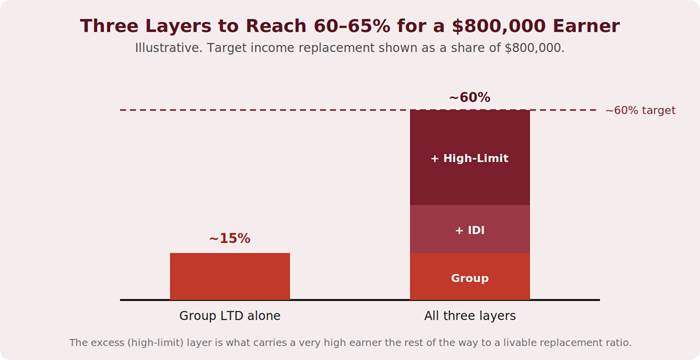
For someone earning $500,000, $800,000, or more those caps translate into a replacement ratio that can fall below 60%, sometimes well below. The higher the income, the smaller the protected slice. A surgeon earning $800,000 with a group plan capped at $10,000/month is looking at roughly 15% replacement before taxes. No amount of shopping the domestic market fixes that; the ceilings are structural.
Where high-limit coverage comes from: Lloyd’s of London
Because domestic carriers stop at their participation limits, the additional coverage is written through the Lloyd’s of London excess and surplus lines marketplace. High-limit disability insurance (sometimes called excess DI or supplemental high-limit coverage) is designed to sit on top of your existing group and individual domestic policies, extending total protection back toward 60–65% of income even at income levels the domestic market can’t touch. Monthly benefits in this market can run to $100,000 or more, and in some structures considerably higher.
A few characteristics distinguish this layer from a standard individual policy:
- It’s excess coverage by design. High-limit policies are built to coordinate with what you already have, filling the space above the domestic ceiling rather than duplicating it.
- Terms are often more flexible for difficult cases. The Lloyd’s market has historically been willing to consider coverage for individuals who have complex medical histories, unusual occupations, high-risk avocations, and other situations the domestic market declines.
- Policies are typically term-based. Many high-limit plans are written for a set period (for example, five years) and renewed subject to review, rather than being locked to age 65 like a non-cancelable individual domestic policy.
- Own-occupation protection is available. For specialists whose income depends on a specific skill set, own-occupation coverage can extend into this excess layer.
How we access the Lloyd’s market
Individuals can’t walk up to Lloyd’s directly; the market is reached through authorized “coverholders”, firms Lloyd’s has approved to quote and bind this coverage on its behalf. At Professional Benefits, we work with two different Lloyd’s of London coverholders. Placing high-limit cases through two independent coverholders rather than one matters for a practical reason: on excess DI, terms, appetite, and pricing can differ meaningfully from one underwriter to the next for the very same applicant. Having two access points lets us compare offers and structure the coverage around your specific income, occupation, and health profile rather than accepting a single take-it-or-leave-it quote.
Who this is really for
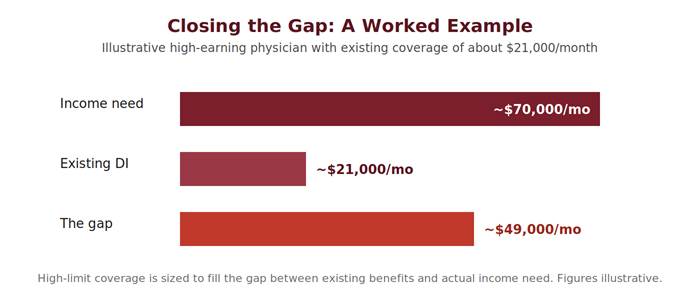
High-limit disability insurance is not a mass-market product; it’s specifically for people whose income has outrun the traditional market. In practice, that tends to mean:
- Physicians and surgeons in high-earning specialties, where a single skill set generates the income and a specialty-specific disability could end it.
- Attorneys, executives, and financial professionals earning well into the six or seven figures, often with large fixed obligations i.e. mortgages, tuition, and lifestyle costs that don’t pause for a disability.
- Business owners and self-employed professionals whose earnings the domestic market struggles to fully insure.
- Businesses with key people as there is a small domestic market for this important business protection.
- Anyone with a large bonus or commission component that group coverage excludes, widening the gap further.
The common thread is a lifestyle and a set of obligations built on an income that traditional disability insurance simply can’t replace on its own.
A few practical notes
High-limit coverage rewards planning. Because the Lloyd’s market underwrites individually and terms vary, the strongest results come from securing coverage while you’re healthy and your income is well-documented. Self-employed applicants in particular benefit from clean, verifiable earnings records, since coverage is sized to actual income. And because these policies coordinate with your existing benefits, it’s worth reviewing the whole portfolio together rather than buying the excess layer in isolation; the goal is a coherent stack that reaches your target replacement ratio, not three disconnected policies.
Common questions about high-limit coverage
Is high-limit income protection expensive? Premiums are higher than standard coverage because the benefit amounts are larger and the risk is concentrated, but the leverage is often substantial. A meaningful monthly benefit for a premium that’s small relative to the income being protected. For someone earning $5–$10 million a year, even a five-figure annual premium can be modest against what’s at stake. The right comparison isn’t the premium in isolation; it’s the premium against the size of the income and fixed obligations it protects.
Does high-limit income protection replace my existing coverage? No it layers on top. High-limit policies are designed to coordinate with your group LTD and individual coverage, filling the space above the domestic ceiling. Keeping the underlying policies in force is usually part of how the excess layer is structured and priced.
What if I’ve been declined elsewhere? This is one of the Lloyd’s market’s strengths. Because it underwrites case by case and is accustomed to non-standard risks, it can sometimes structure coverage with unique exclusions for preexisting conditions for applicants the domestic market turned away for health history, occupation, or avocation. It isn’t guaranteed, but it’s frequently an option where the traditional market has none.
How long does high-limit income protection last? Many high-limit plans are written for a set term and renewed subject to review, rather than locked to age 65. That’s a genuine difference from a non-cancelable individual policy, and it’s worth understanding the renewal terms up front so there are no surprises at review time.
The takeaway
For earners above roughly $500,000, the traditional disability market runs out of room. Group LTD and even a fully underwritten individual policy leave a large, permanent gap because domestic carriers cap the income they’ll insure. High-limit disability insurance, written through the Lloyd’s of London excess marketplace, is the layer built to close that gap, extending protection back toward 60–65% of income at levels the domestic market won’t reach, with flexibility for difficult health and occupational profiles. Because terms and pricing vary by underwriter, access matters: we place these cases through two different Lloyd’s of London coverholders so the coverage can be shopped and structured around your specific situation rather than a single quote.
Author – Stevan Collins, CLU, CEBS, DIA
Executive Benefits Consultant , Professional Benefits Incorporated — Sarasota, Florida
View full bio at professionalbenefits.org/meet-the-team
Sources: Exceptional Risk Advisors, Definitive Guide to Lloyd’s of London Disability Insurance
This article is for educational purposes only and is not individualized financial, tax, or insurance advice. Coverage availability, terms, limits, and pricing vary by carrier, coverholder, health, occupation, and jurisdiction. Consult a licensed professional regarding your specific situation.