
The Building Blocks of Income Protection
Most people insure the things their income pays for; the house, the cars, their health while leaving the income itself uninsured. Yet your ability to earn a paycheck is very likely the most valuable asset you own. A 40-year-old earning $200,000 who works another 25 years will earn $5 million before any raises. Protecting that engine is what income protection is all about.
This first post in our executive benefits series lays the groundwork: what income protection actually is, the layers that make it up, and why the coverage most people assume will catch them often falls short. Later posts go deeper into the group long-term disability gap and the individual policy riders worth understanding.
Why income protection deserves your attention
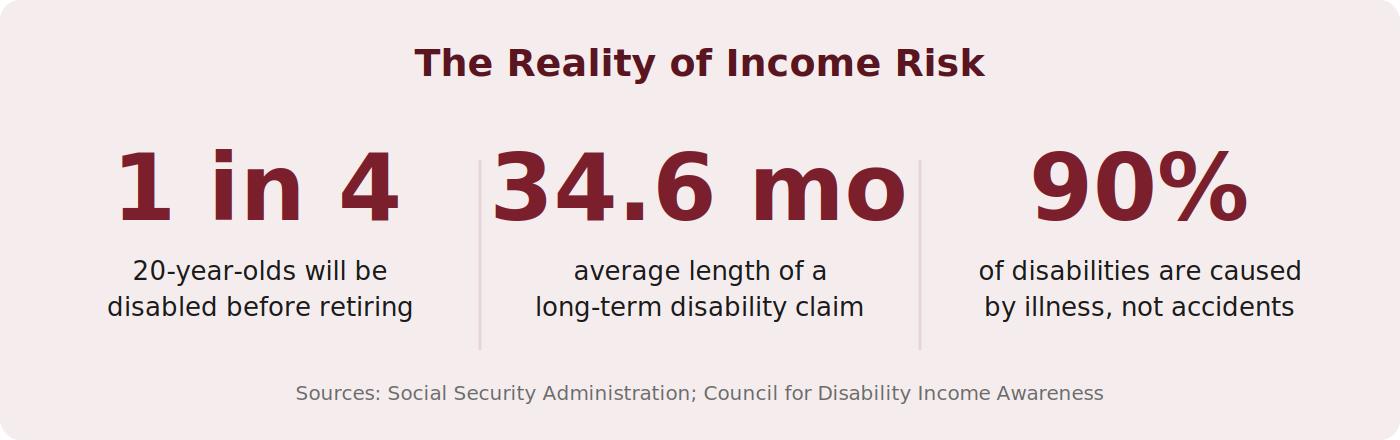
The risk here is not abstract. According to the Social Security Administration, roughly 1 in 4 of today’s 20-year-olds will become disabled for a year or more before reaching retirement age. And when a disability does strike, it tends to last: the average long-term disability claim runs about 34.6 months, nearly three years without a paycheck.
Contrary to what most people picture, these events are rarely dramatic accidents. Roughly 90% of disabilities are caused by illness, not injury i.e. cancer, cardiovascular disease, musculoskeletal disorders, and mental health conditions lead the list. This is precisely why savings alone are a fragile plan. Surveys have repeatedly found that around half of Americans could not cover more than three months of expenses from savings, and a three-year income interruption would exhaust the reserves of all but the most disciplined savers.
The Five layers of income protection
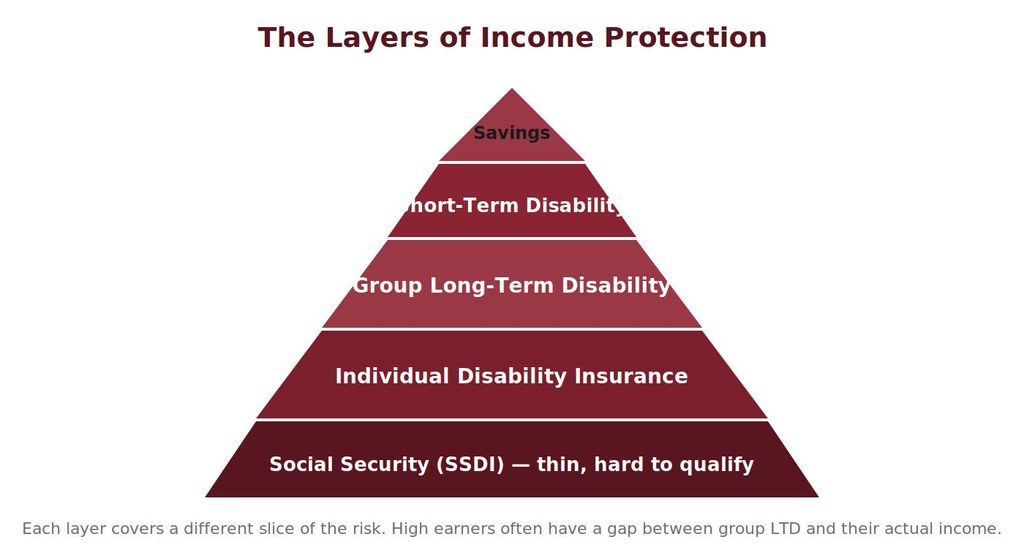
Income protection isn’t a single product – it’s a stack of layers, each covering a different portion of the risk. Understanding where each layer starts and stops is the key to seeing your own exposure clearly.
1. Emergency savings — the first, thinnest layer
Cash reserves handle brief interruptions: a few weeks out, an unexpected bill. They’re essential, but they were never designed to replace years of income. For a high earner with a large fixed-cost lifestyle, even a healthy emergency fund is measured in months, not years.
2. Short-term disability (STD)
Short-term disability typically covers the first 90 to 180 days of a disability, bridging the gap between when you stop working and when longer coverage begins. Benefits usually replace a percentage of base pay, and for many earners this window can be managed through savings or salary continuation. STD solves the near-term problem, not the catastrophic one.
3. Long-term disability (LTD) – employer group coverage
This is the layer most professionals rely on, and it’s where the story gets more complicated. Group LTD generally replaces about 60% of pre-disability earnings, but almost always subject to a monthly benefit cap often somewhere between $10,000 and $15,000 a month regardless of what you earn. It also frequently covers base salary only, excluding bonus, commission, and equity compensation. For a mid-income employee, 60% works as intended. For a high earner, the cap quietly turns 60% into something much smaller. (We devote the entire next post to this gap and how to close it.)
4. Individual Disability Insurance (IDI)
Individual Disability Insurance is a personally owned policy that sits above the group plan, picking up income the group cap leaves uncovered and typically restoring the total replacement ratio toward 60–70% of income. This is owned by the individual and not tied to employment, unlike Group LTD.
5. Government programs — a thin safety net
Social Security Disability Insurance (SSDI) exists, but it’s not a realistic plan for a high earner. Approval is difficult — historically only about 30% of SSDI claims are ultimately approved — and the benefit is modest, averaging roughly $1,580 per month in recent SSA data. For someone accustomed to a professional income, SSDI barely registers.
Where the layers leave a gap
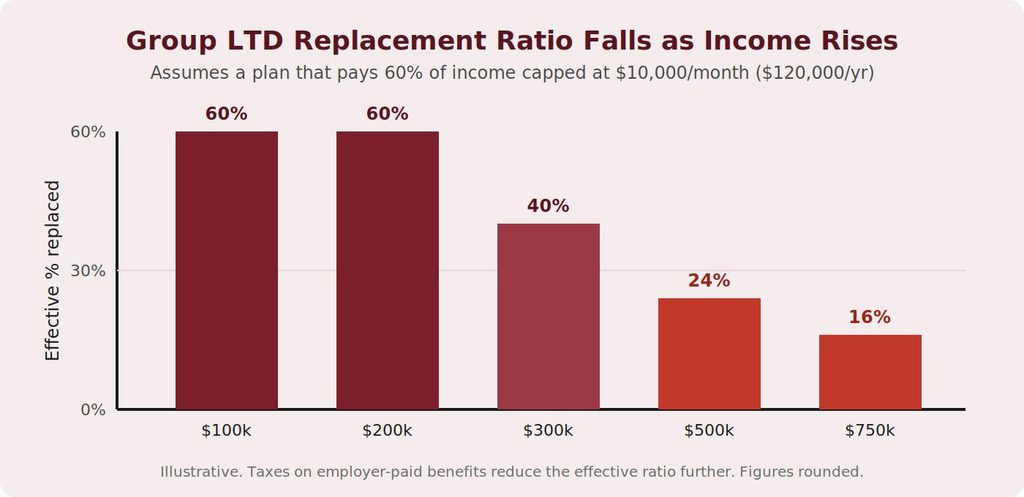
Stack those layers together and a pattern emerges. For someone earning $80,000, group LTD’s 60% replacement does roughly what it promises. But as income climbs past the plan’s cap, that same 60% shrinks in real terms. A $500,000 earner covered by a plan capped at $120,000 a year is looking at an effective replacement of around 24%, before taxes further reduce it, since employer-paid LTD benefits are generally taxable.
This is the counterintuitive heart of income protection: the more you earn, the smaller the percentage of your income your group plan actually protects. It’s sometimes called “reverse discrimination” in the benefits world, and it’s the specific problem the next two posts in this series address. First by dissecting the group LTD gap, then by walking through the individual disability policy features that close it.
How to think about your own coverage
A useful way to frame the question: a well-designed income protection plan generally aims to replace at least 60% of your after-tax income, structured so the benefit actually reaches you when you need it. To gauge where you stand, it helps to know three things about your current coverage:
- The replacement percentage and the monthly cap. Sixty percent means little if the dollar cap kicks in well below your income.
- What counts as “income.” Base salary only, or does it include bonus, commission, and other variable pay?
- Who pays the premium. This determines whether your eventual benefit is taxable (employer-paid) or tax-free (you paid with after-tax dollars) — a difference that can swing your real replacement ratio by ten points or more.
Those three answers reveal the size of your gap. In the next post, we’ll dig into group long-term disability specifically — how the cap works, why high earners are most exposed, and how an individual disability policy layers on top to rebuild the protection the group plan can’t provide.
The takeaway
Your income is the asset that funds everything else, yet it’s the one most people leave least protected. Income protection is best understood as a stack of layers (savings, short-term disability, group long-term disability, individual coverage, and a thin government backstop) each doing part of the job. For high earners, the layers frequently don’t reach all the way up to their actual income, and that gap is invisible until a claim exposes it. Understanding the structure is the first step to fixing it.
Author – Stevan Collins, CLU, CEBS, DIA
Executive Benefits Consultant , Professional Benefits Incorporated — Sarasota, Florida