
Life insurance is a powerful tool and can be used in so many different ways. From pre-retirement death benefit, to supplemental retirement income, estate tax funding and charitable planning. Despite being considered an old fashioned product, its flexibility allows for innovative solutions to a lot of benefit needs. Our experience allows us to be creative and our independence allows us to be strategic.
Start with Why you need Life Insurance
The most common reason for life insurance is providing financial security to your loved ones in the event of your unexpected passing (pre retirement death benefit). It naturally helps cover immediate expenses like funeral costs, outstanding debts, mortgage payments, student loans and daily living expenses for dependents.
Beyond basic protection, life insurance can serve as a tool for estate planning, ensuring your assets are passed on efficiently while minimizing tax burdens. For families with young children or single-income households, it replaces lost income to maintain their standard of living.
Life insurance can also be utilized a number of ways for Charitable Planning and as part of an executive benefit package to aid in retention.
How to Figure Out How Much Life Insurance You Need
This is complex to give a single answer to because it depends on your goal and overall financial situation! In our opinion if your goal is:
- Pre Retirement Death Benefit you need to consider first major debts you would want to pay off (mortgages, car loans, student loans or credit cards), add any future expenses such as college tuition you would want to pay off and then determine how much income you want to provide your loved ones and divide that by 5% which calculates how big a lump sum is needed to generate that income. Your goal might be some of this or something else entirely, which is okay! Life insurance calculations that attempt to 'do it all' generate numbers far greater than most people have or believe reasonable.
- Post Retirement Estate Planning this can be to avoid taxation for high net worth individuals or as part of a gifting strategy for your loved ones. To know how much life insurance is required you would need to project the tax or size of gift that you wish to fund.
- Charitable Planning you need to either work with the charity in question to determine your goals OR if you want to give them a generous surprise you can pick the amount in question. You may even chose to use your group employer paid benefits for this.
- Executive Benefits the biggest factor is what is the employer's objective. Is it enhancing current life insurance benefits? Funding a buy-sell agreement? Providing for Golden Handcuffs?
Types of Life Insurance
Understanding the different types of life insurance is key to choosing the best policy for your situation. Here's an overview of the main options:
Term Life Insurance: This is the most straightforward and affordable type, providing coverage for a specific period (e.g., 10, 20, or 30 years). It pays out a death benefit if you pass away during the term but has no cash value accumulation.
Universal Life Insurance: Another permanent option with flexibility in premiums and death benefits. It also builds cash value based on interest rates, allowing adjustments as your needs change.
Whole Life Insurance: A permanent policy that lasts your entire lifetime, as long as premiums are paid. It includes a cash value component that grows over time, which you can borrow against. Premiums are higher but remain level.
Indexed Universal Life Insurance: Ties cash value growth to a stock market index, providing a balance of protection and potential returns without direct market exposure.
Average Cost of Term Life Insurance
The average cost of term life insurance varies based on factors like age, gender, health, coverage amount, and term length. For a healthy 30-year-old non-smoker, a $500,000, 20-year term life insurance policy might cost around $25-$35 per month.
Smokers or those with health issues face higher premiums. Even if you have a complex health history, working with a broker who shops around can obtain you the best price.
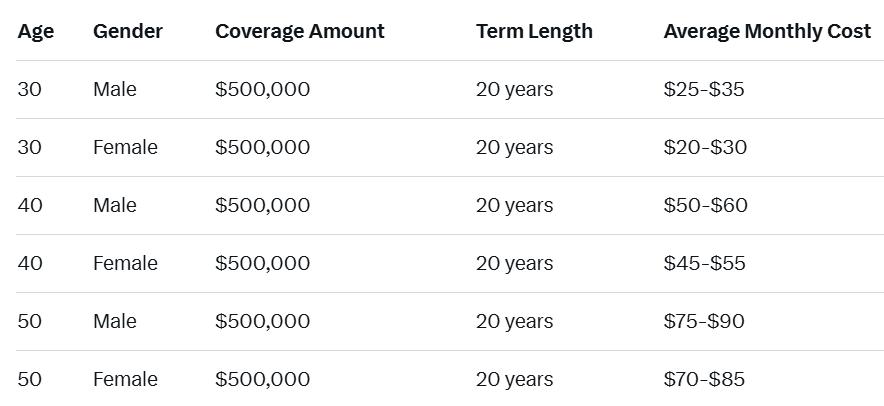
These figures are estimates based on 2026 data for non-smokers in excellent health; actual quotes may vary.
Options to Obtain Life Insurance
There are three main ways to obtain life insurance:
Individually (with or without a spouse) can be anywhere from instant issue through to robust medical underwriting (medical questionnaire, exam, record review are common). It is very common to have follow up questions on any pre-existing health conditions. You can be declined or have your cost increased "rated up" due to pre-existing conditions.
Group Benefits usually does not have medical underwriting (up to the limits in the contract). It is often free up to $50k of employer paid base coverage. We usually recommend employees to take any free coverage, and any guaranteed issue amounts available when first hired.
As an executive benefit package where it is guaranteed issue. Starts at a group of 10 executives and usually means there are no medical requirements beyond the employer confirming they are actively at work on a full time basis. There are options for term life through more permanent coverage as well as employer-paid or employee-paid options.
Get Your Free Life Insurance & Executive Benefits Review
Depending on your situation, life insurance discussions may also require consultation with your tax and legal professionals, which we would encourage and are happy to be a part of.
Ready to explore your life insurance options? Contact us today for a complimentary review of your executive benefits, including personalized life insurance recommendations.